Dual-mass flywheel
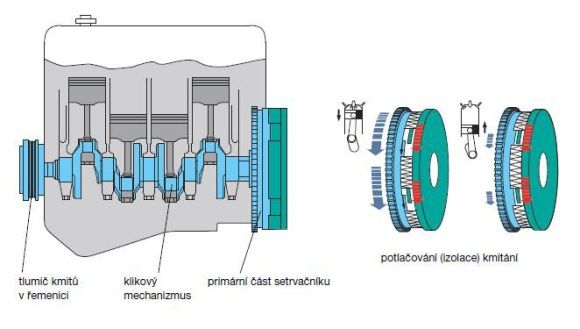
The dual-mass flywheel performs the same function as a conventional single-mass flywheel. However, the mass of the dual-mass flywheel is divided into two parts, with the main heavy part being elastically connected to the crankshaft. Thanks to this design, the dual-mass flywheel transmits its kinetic energy smoothly and dampens torsional vibrations.
In the 1980s, development focused on increasing vehicle efficiency through weight optimization and the reduction of friction in the drivetrain. At the same time, diesel power units began to gain wider acceptance in passenger cars, and torque values increased. The reduction of friction combined with increased rotational irregularities, particularly in diesel engines, led to higher gearbox vibrations and noise. High-performance power units generated torsional vibrations that were transmitted to the vehicle body, and this unrest reduced driving comfort. The company LuK introduced a solution in the form of the dual-mass flywheel ZMS (Zweimassenschwungrad). The dual-mass flywheel entered series production in 1985 and was initially installed in upper-class vehicles. The first automobile manufacturer to show interest in this new design element was BMW.
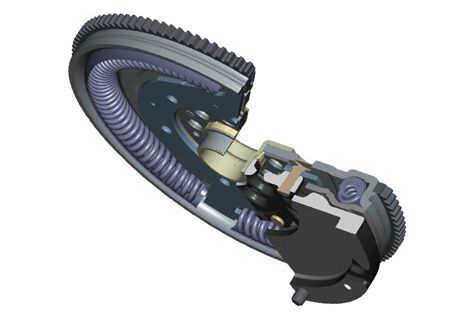
The two separate masses of the dual-mass flywheel are interconnected by a system of spring dampers, which attenuate engine vibrations. The dual-mass flywheel therefore enables comfortable driving even at low engine speeds, where irregular engine operation is most pronounced. The mass of the flywheel depends on the specific design for a given vehicle, but on average it ranges between 15 and 20 kg.
Principle
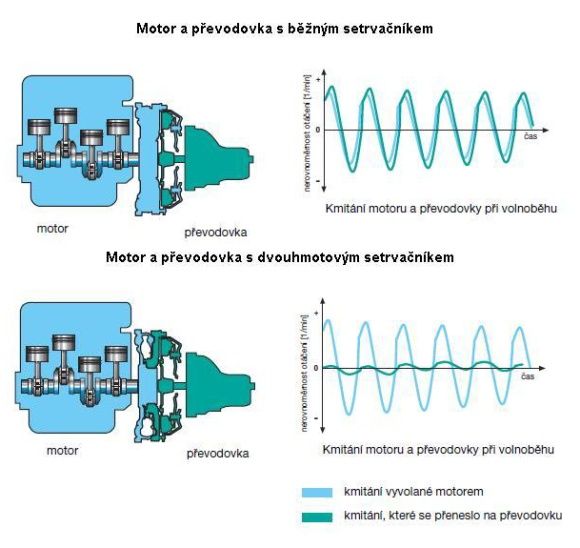
Due to the uneven rotational motion of the crankshaft caused by the ignition system, torsional vibrations are generated in the power unit. These vibrations are transmitted to the gearbox, where they create noise resulting from the mutual impacts of unloaded gear wheels. Through the engine mounting, this noise is then transmitted to the vehicle body. By using torsional dampers that allow limited elastic angular displacement between the crankshaft and the gearbox input shaft, these adverse effects can be reduced. In a conventional clutch, the torsional damper is also located in the clutch disc. However, in many vehicles the residual uneven torque is too large, making the use of a dual-mass flywheel necessary. The flywheel mass is divided into a primary and a secondary mass. The primary part of the flywheel is bolted to the crankshaft. The secondary part is rotatably mounted on the primary part by means of a plain bearing. The secondary part also forms the friction surface for the clutch disc. The secondary mass must be positioned in the torque flow ahead of the clutch; otherwise, it would have to be synchronized during every gear change. Relative rotation between the primary and secondary parts is assisted by planetary gears. The springs are connected in series at the largest diameter. The transmission of spring forces is achieved using sliding shoes, making it possible to use standard straight coil springs. The series arrangement of the springs allows combinations of different springs, thereby achieving the required spring characteristics. If the springs are fatigued or damaged, the fault manifests itself as impacts during gear shifting. Stops are located at the extreme angular positions of the flywheel rotation.
Flywheel Energy
The kinetic energy Ek stored in a rotating flywheel is calculated using the following formula:
Ek = 1/2 · J · ω2,
where J is the moment of inertia of the body with respect to the axis of rotation, and ω is the angular velocity at which the body rotates.