Vanos (Double-Vanos)
The abbreviation VANOS refers to BMW engines equipped with variable valve timing technology. Variable valve timing is used to optimise engine performance, helping to achieve higher power output and lower fuel consumption.
Modern BMW petrol engines are equipped with the VANOS system, BMW’s technology for variable valve timing. Variable valve timing systems are used to improve gas exchange in the cylinders of reciprocating internal combustion engines. Further details can be found in our article on variable valve timing.

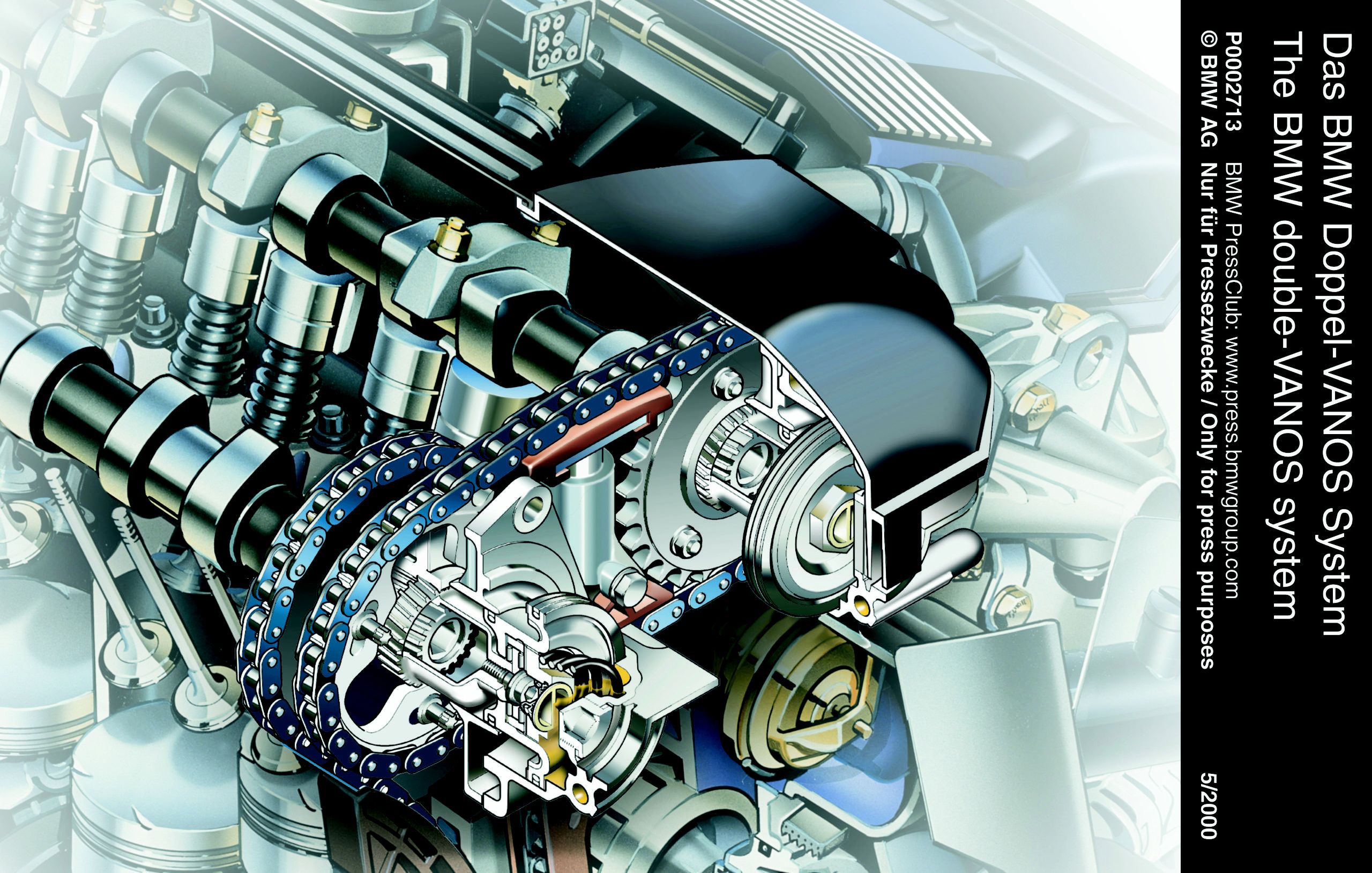
The abbreviation VANOS comes from the German term VAriable NOckenwellenSteuerung (variable camshaft control). It is one of several technical solutions that allow the adjustment of valve timing. BMW introduced this technology in 1992 with its M50 engine. Based on engine speed and accelerator pedal position, the VANOS system adjusts the angular position of the intake camshaft, allowing valve timing to be shifted by up to 42° relative to the crankshaft.
In 1996, BMW introduced a further improvement to its valve train technology. Unlike the original VANOS system, which controlled only the intake valve timing, the new Double VANOS system also controls the exhaust camshaft. This allows even more precise control of valve timing and improves engine operation across different speeds and loads.
Operating principle:
The camshafts are equipped with electrohydraulically controlled mechanisms that allow their angular position to be adjusted relative to the crankshaft according to commands from the engine control unit. Earlier versions of the system operated with two predefined positions, while newer versions provide continuously variable adjustment.

Did you know?
In its pursuit of optimising the combustion process and improving gas exchange in the cylinders, BMW went even further. In 2001, the company introduced another system capable of continuously adjusting valve lift, which it named Valvetronic.